

Thousands of people have transformed the way they plan their business through our ground-breaking financial forecasting software. Having a business planning cycle helps your vision to keep on track, but what exactly is the process? Designed to simplify complex forecasting tasks, Brixx allows horizontal analysis formula accountants to create, manage, and consolidate multiple business forecasts in one streamlined platform.
Sales Programs

It helps you understand how efficiently a company is managing its costs and whether there are any notable changes in expense categories over time. Once you have gathered the necessary financial statements, the next step is to calculate the dollar amount changes for key financial metrics between the base year and the current year. Dollar amount changes provide a clear picture of the absolute differences in financial figures over time. Understanding these key concepts is vital as they form the foundation for effective horizontal analysis, enabling you to gain meaningful insights into a company’s financial performance and trends. To perform horizontal analysis, select a base period and compute the change in each financial statement item by subtracting the base period amount from the current period amount.
Best Practices Recap and Future Considerations
- By comparing revenue, operating expenses, and net income over time, you can measure growth and efficiency.
- This broader application helps managers spot operational improvements or declines that support more informed decision making.
- Designed to simplify complex forecasting tasks, Brixx allows accountants to create, manage, and consolidate multiple business forecasts in one streamlined platform.
- Product augmentation leads the marketer to look at the user’s total consumption system i.e. the way the user performs the tasks of getting, using fixing and disposing of the product.
- Some of the earliest documented uses of horizontal analysis date back to the 1920s and 1930s when accounting textbooks and publications began covering it as an important analytical approach.
- A company’s financial statements – such as the balance sheet, cash flow statement, and income statement – can reveal operational results and give a clear picture of business performance.
The Comparative Income Statement is drawn on the same principle as the Horizontal Balance Sheet. The percentages reflects the changes that have occurred over successive periods. The Vertical Analysis income statement Fig (2) reveals what portion of sales has been absorbed by various costs, and expenses incurred and the percentage of the total sales that remains as net income. For example, the table shows that 60 percent of total sales are incurred as cost of goods sold and only 13.54 percentage of total sales are in the form of net income to the firm. Liability analysis through horizontal analysis exposes financial strategy and risk management.
Marketing Programs

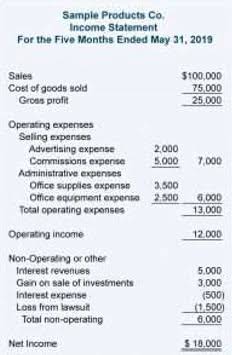
Income statements provide valuable insights into a company’s revenue, expenses, and profitability over time. By analyzing these components, you can gain a https://vcertech.com/financial-ratios-complete-list-and-guide-to-all-7/ deeper understanding of the company’s financial performance. Comparative financial statements serve as the cornerstone of horizontal analysis. These statements present financial data from different periods, often two or more years, side by side.
- For example, in the income statement, we can, based on historical data and trends, make assumptions about sales growth and then forecast the sales growth rates through the forecast periods.
- It can also be used to project the amounts of various line items into the future.
- To proceed with the process of horizontal analysis, financial individuals need to gather financial information about a company for various accounting periods.
- Further, when working with large data sets, we recommend cleaning up the data to improve the overall visual representation of the analysis.
- With your findings, you understand how much change you have in your revenue (increase or decrease) between the two periods in consideration and also spot changes in your COGS and net income.
- Additionally, the financial statements to be provided need to be respective statements for the accounting periods to be compared.
- A financial analyst can manipulate the conclusions of horizontal analysis based on the year he chooses as the base year and how many accounting periods he takes into consideration for drawing the comparison.
They also help you see trends in real-time, and make Foreign Currency Translation it faster to spot changes and make crucial decisions. On the other hand, comparability constraint dictates that a company’s financial statements and other documentation be such that they can be evaluated against other similar companies within the same industry. Horizontal analysis is used to improve and enhance these constraints during financial reporting. Consistency constraint here means that the same accounting methods and principles must be used each year since they remain constant over the years. When examining financial statements, the investment analyst focuses immediate attention on significant items only.

Step 2 – Calculate nominal changes
Large percentage changes frequently occur in items whose amounts may not be significant compared with other items on the statements. For example, although a large percentage change occurred in Prepaid Expenses, the analyst would scarcely notice this item in an initial examination of changes. The left hand side of the balance sheet shows asserts of Annapurna Textile Inc. whereas the right hand side shows the liabilities and equity as on Dec 2006.
- By comparing these figures over time, it is easier to identify trends in profitability.
- It’s the flashlight that cuts through the fog of financial data, showing you where the real opportunities (and risks) lie.
- The method is also called trend analysis because it shows a business’s performance trajectory.
- In 85% of the companies analysed, the study discovered that normalising data in this manner resulted in more precise performance assessments, thereby enhancing strategic decision-making and financial planning.
- Horizontal analysis offers a powerful lens through which finance professionals can spot trends, understand the dynamics of financial performance over time, and make informed decisions that drive strategic success.
- For instance, a senior executive wouldn’t base their strategy on a single revenue figure without understanding how it compares to previous periods.
Interested in a product Demo?
In 85% of the companies analysed, the study discovered that normalising data in this manner resulted in more precise performance assessments, thereby enhancing strategic decision-making and financial planning. The cash flow statement is also beneficial for horizontal analysis, in addition to the income statement and balance sheet. To conduct horizontal analysis, collect financial statements prepared according to GAAP, determine comparison methods, calculate absolute and percentage changes between periods, and analyse trends. Horizontal analysis is a financial analysis technique that compares financial information over multiple periods to identify trends and changes. Horizontal analysis is used to assess a sequence of financial statement data over a specified time frame.